What we asked
Between July and August 2025, we shared and engaged on three design ideas for High Street’s future.
Each idea:
- responded to the Community Aspirations - what we’ve heard from businesses, residents and visitors to High Street
- reflected different ways the street could support how people live, move, shop, dine and connect
- presented a different level of change – from a lighter upgrade to a larger transformation
- varied in cost and approach to construction
We asked:
- How well the three ideas supported the community aspirations
- What worked well and what needed more thought
- How well each idea balanced the community aspirations, construction impacts and cost
Idea A
A refreshed street, keeping its current layout
A lighter-touch idea that largely keeps the street’s current layout and look, makes the existing footpath extensions more durable and includes targeted upgrades to help the street function better.
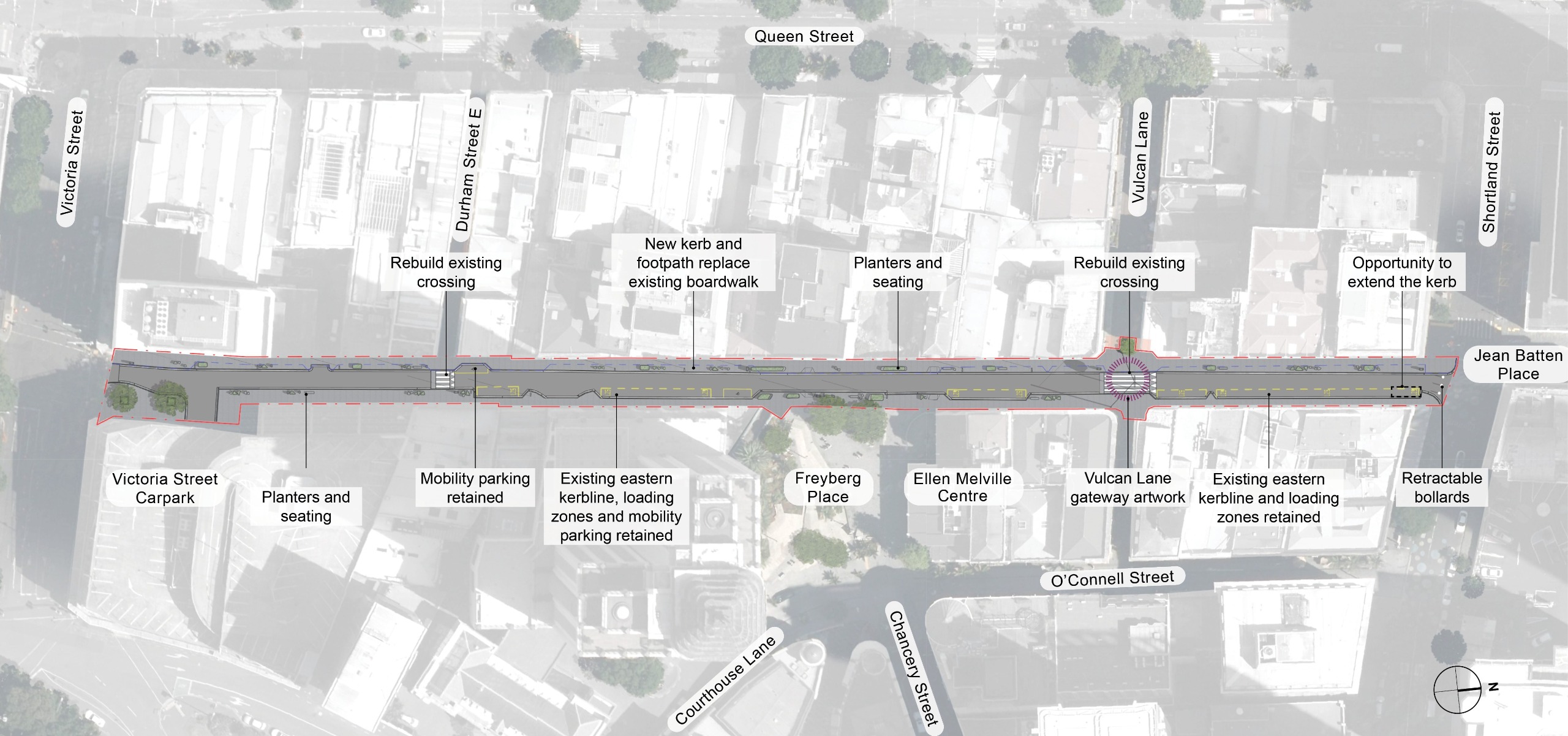
Click on the icons to view key features of the design and sketches of what it could look like.
Click the arrows in the top right corner to expand the image.
Retains current feel
- High Street would largely keep its current layout and feel.
Targeted upgrades to refresh the street
- Road would be resurfaced to repair wear and tear and help extend its life.
- Existing footpath would largely remain in place, with repairs made to areas that need it.
- Targeted improvements would build on what’s already there – including seating, planting or public art where space allows.
Better walking experience
- Timber boardwalk would be replaced with a durable, paved footpath.
- Pedestrian crossings would be rebuilt.
- Planters would be repositioned to create more space for people.
More space when people need it
- From 11am–2pm on weekdays, vehicles wouldn’t be allowed on High Street, making more room for people and outdoor use, for things like pop-up dining or events.
- Emergency service vehicles and vehicles exiting the Victoria Street carpark would still be able to access the street between 11am-2pm.
- Outside 11am-2pm on weekdays, deliveries and vehicle access would continue as normal.
- Loading zones would remain in their current locations, operating:
- 6am-11am and 2pm-10pm on weekdays
- 6am-10pm on weekends
- Between the pedestrian priority hours of 11am-2pm on weekdays, loading and servicing would occur elsewhere.
- Emergency service vehicles and vehicles exiting the Victoria Street carpark would still be able to access the street between 11am-2pm.
- On-street paid parking would be retained overnight, between 10pm-6am.
- The two existing mobility parking spaces would be retained.
- Construction is estimated to take up to 6 months.
- Work would be done in stages, moving along the street section by section.
- We’d explore low-impact methods to manage disruption, building on top of what’s already there.
- You would experience some noise and see temporary fencing around work areas that move along the street as work progresses.
- Access to businesses and for walking, deliveries and driving would remain open, though there may be temporary changes.
- We’d continue to coordinate with utility providers to reduce impacts.
- We estimate that this idea would cost between $5-$7 million to deliver.
- Any budget not needed would go back into the city centre targeted rate fund – to be invested into other improvements across the city centre.
Idea B
A people-friendly central block
A balanced idea that upgrades the central block around Freyberg Place into a kerbless shared space that can be used flexibly. The rest of the street largely keeps its current layout and look, makes the existing footpath extensions more durable and includes targeted upgrades to help the street function better.
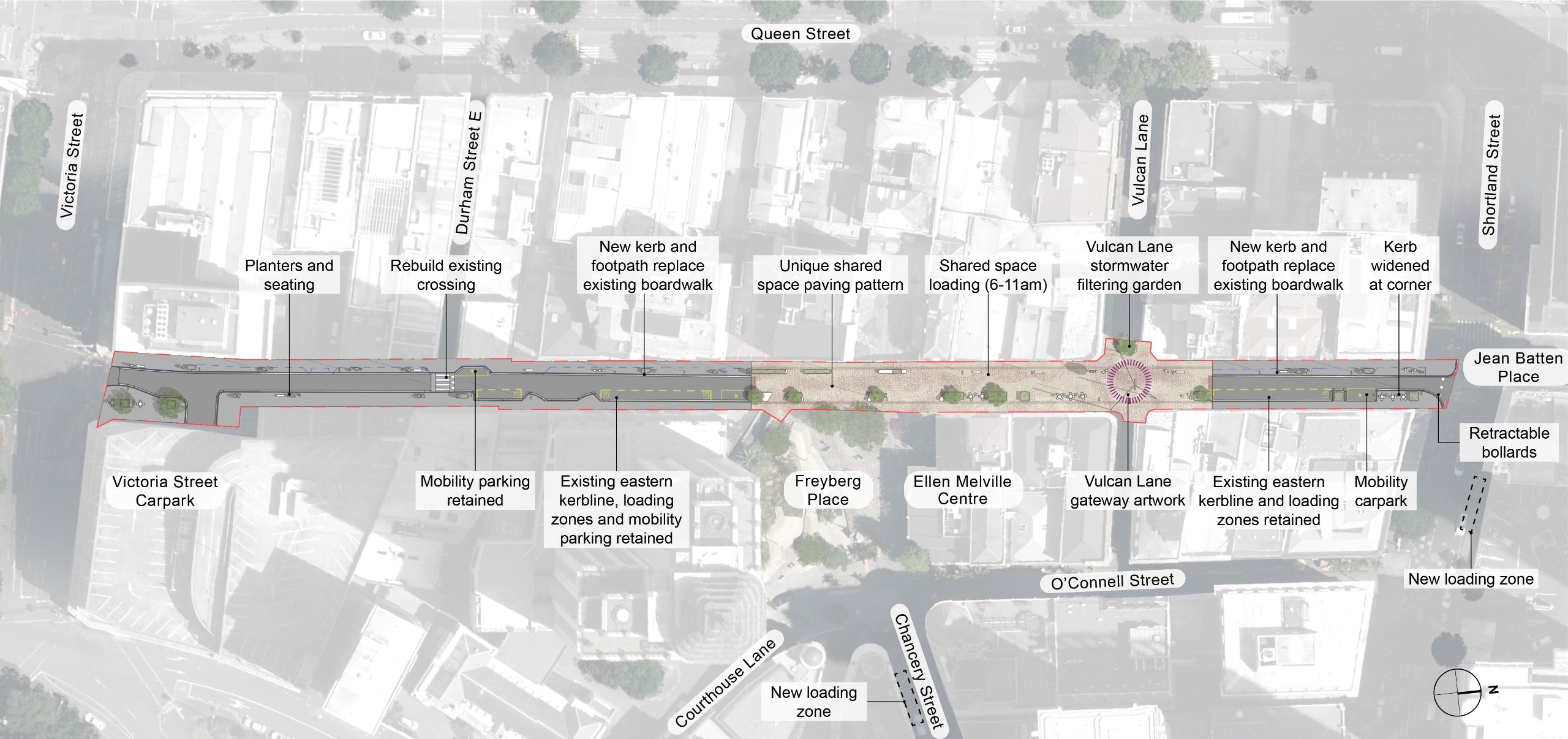
Click on the icons to view key features of the design and sketches of what it could look like.
Click the arrows in the top right corner to expand the image.
Retains current feel, providing more space for people
- Northern and southern ends would keep their current layout and feel.
- Central block would be upgraded to a kerbless people-focused space, drawing people in and improving connections to the wider district.
- Road would be resurfaced to repair wear and tear and help extend its life.
Better walking experience
- Timber boardwalk would be replaced with a durable, paved footpath outside of central block.
- Existing footpath would largely remain in place, with repairs made to areas that need it.
- Pedestrian crossings would be rebuilt.
- Planters would be repositioned to create more space for people.
More space when people need it
- From 11am–2pm on weekdays, vehicles wouldn’t be allowed on High Street, making more room for people and outdoor use - for things like pop-up dining or events – especially in the central block.
- Emergency service vehicles and vehicles exiting the Victoria Street carpark would still be able to access the street between 11am-2pm.
- Outside 11am-2pm on weekdays, deliveries and vehicle access would continue as normal.
Reflects unique identity
- In the central block, we’d explore additional opportunities for design, planting and storytelling elements to reflect High Street’s identity and celebrate its uniqueness.
More welcoming
- Improved lighting and larger improvements in the central block would help make the area feel more welcoming and safer, especially at night.
- Outside of the central block, targeted improvements would build on what’s already there – including seating, planting or public art where space allows.
- Loading zones would remain in their current locations, (south of Freyberg Place, north of Vulcan Lane), operating:
- 6am-11am and 2pm-10pm on weekdays
- 6am-10pm on weekends
- Loading and servicing would be available in the central shared space area between 6am-11am.
- Between the pedestrian priority hours of 11am-2pm on weekdays, loading and servicing would occur elsewhere.
- Emergency service vehicles and vehicles exiting the Victoria Street carpark would still be able to access the street between 11am-2pm.
- On-street paid parking would be retained overnight, south of Freyberg Place and north of Vulcan Lane, between 10pm-6am.
- New loading zones would be introduced on Chancery Street and Shortland Street.
- Three mobility parking spaces would be provided, including:
- The two existing spaces
- One new space, north of Vulcan Lane
|
- We estimate that this idea would cost between $11-$13 million to deliver.
- Any budget not needed would go back into the city centre targeted rate fund – to be invested into other improvements across the city centre.
Idea C
A people-first street, from end to end
A transformational idea that upgrades the full length of High Street, from Shortland Street to the Victoria Street carpark, into a pedestrian priority shared space, with new pavements, greenery and street furniture.
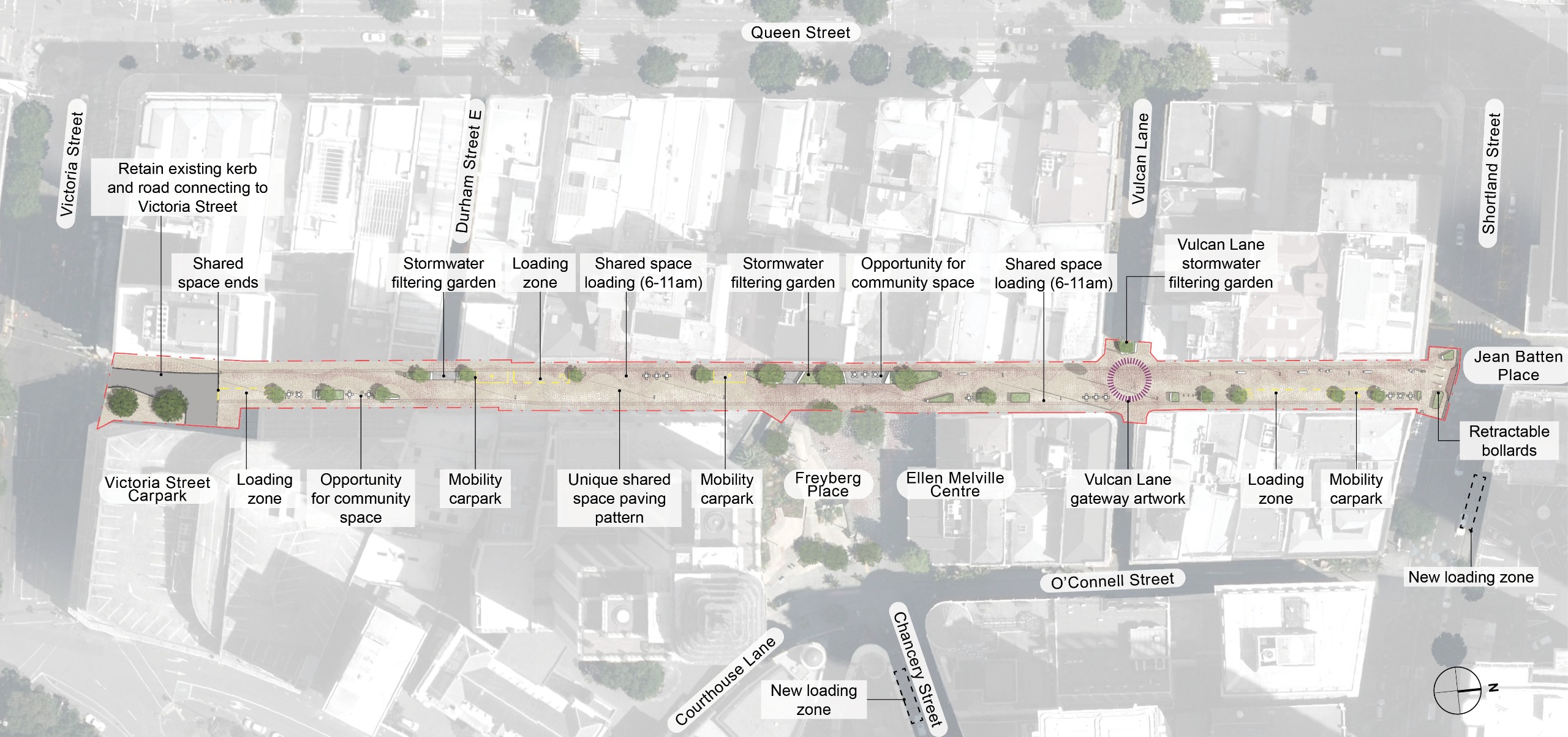
Click on the icons to view key features of the design and sketches of what it could look like.
Click the arrows in the top right corner to expand the image.
A street that’s made for people
- With more space to walk, sit and spend time, the street would feel more inviting, reinforce High Street as a destination, increase vibrancy and encourage people to stay longer.
Better walking experience
- The entire street would be a continuous, level surface that reduces trip hazards and supports universal access - making it easier for people walking and using wheelchairs, prams, walkers, or mobility aids.
Safer and more welcoming
- Improved lighting across the whole street would help make it feel more welcoming and safer, especially at night.
More space when people need it
- From 11am–2pm on weekdays, vehicles wouldn’t be allowed on High Street, making more room for people and outdoor use, for things like pop-up dining or events.
- Emergency service vehicles and vehicles exiting the Victoria Street carpark would still be able to access the street between 11am-2pm
- Outside 11am-2pm on weekdays, deliveries and vehicle access would continue as normal.
Green and cared for
- Additional planting and garden areas would provide a greener High Street and help treat stormwater.
Reflects unique identity
- Throughout the whole street, we’d explore additional opportunities for design, planting and storytelling elements to reflect High Street’s identity and celebrate its uniqueness.
Stronger connections
- Improved paving, signage and a design that responds to visual cues from Freyberg Place and nearby laneways – would help people find their way, discover what's nearby and want to return.
- Loading zones would be provided at three locations at all times except for between 11am-2pm on weekdays:
- north of the Victoria Street carpark exit
- north of Durham Street East
- north of Vulcan Lane
- Loading and servicing would be available in the shared space area between 6am-11am.
- Between the pedestrian priority hours of 11am-2pm on weekdays - it would occur elsewhere.
- New loading zones would be introduced on Chancery Street and Shortland Street.
- Emergency service vehicles and vehicles exiting the Victoria Street carpark would still be able to access the street between 11am-2pm.
- On-street paid parking would not be available.
- Three mobility parking spaces would be provided:
- One space north of Durham Street East
- One space south of Freyberg Place
- One space north of Vulcan Lane
- Construction is estimated to take between 18-24 months.
- Work would be done in stages, with the first parts of High Street reopening after 12 months.
- Work would involve excavation to upgrade utilities, improve drainage, and install new paving, lighting and planting.
- Intensive periods of construction would take place, including noise, dust and activity throughout different parts of the street over time.
- A temporary vehicle route through Freyberg Place would help maintain vehicle access.
- Access to businesses and for walking, deliveries and driving would remain open, though there may be temporary changes.
- We’d continue to coordinate with utility providers to reduce impacts.
- We estimate that this idea would cost between $22-$24 million to deliver.
- Any budget not needed would go back into the city centre targeted rate fund – to be invested into other improvements across the city centre.